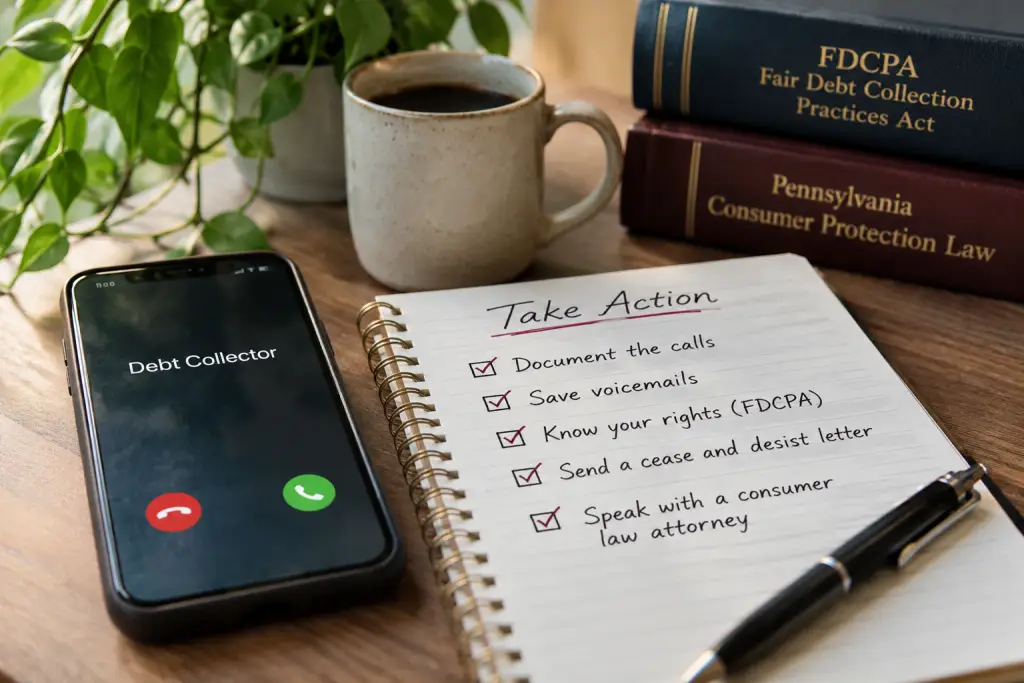
Facing debt collector harassment in Pennsylvania? Learn your FDCPA rights, how to document abusive calls, and when to contact a consumer protection attorney.
Debt collectors rely on fear and confusion to force payments. When phone calls cross the line into threats or relentless ringing, you are experiencing illegal debt collector harassment. The Fair Debt Collection Practices Act (15 U.S.C. § 1692 et. seq.) protects you from these abusive tactics. The Law Office of Emily Gomez, LLC helps Pennsylvania consumers hold aggressive collection agencies accountable and enforce their legal rights.
What qualifies as debt collector harassment under federal law?
The Fair Debt Collection Practices Act (FDCPA) is the primary federal law governing debt collection practices. Specifically, 15 U.S.C. 1692d outlines exactly what constitutes harassment or abuse by debt collectors. The law prohibits agencies from engaging in conduct meant to annoy, abuse, or harass any person in connection with the collection of a debt.
Debt collectors cannot contact you before 8 a.m. or after 9 p.m. in your local time zone unless you explicitly agree to those hours. They also face strict limits on call frequency. A collector cannot call you more than seven times within a seven-day period on a particular debt. If they actually speak with you about a particular debt, they cannot call you again about that same debt for another seven days.
Abusive language is strictly prohibited. Collectors cannot use profane or obscene language. They cannot threaten violence or physical harm. The Consumer Financial Protection Bureau (CFPB) enforces these rules alongside the Federal Trade Commission (FTC). According to a 2024 FDCPA Annual Report, consumers frequently report that debt collectors illegally impersonate attorneys or law enforcement officials. Collectors also break the law when they falsely claim you have committed a crime by failing to pay a debt. If you experience these tactics, you have grounds to take legal action. You can learn more about your rights on our debt collector harassment services page.
The rules for debt validation and communication
When a collection agency first contacts you, they must follow specific “validation” rules. A debt collector must provide you with certain information either during the initial communication or within five days of that first contact. This information must include, among other things, the name of the current creditor, the exact amount owed, a statement explaining that if the debt is disputed the debt collector will mail you “verification” information, and a statement explaining that, upon request, the debt collector will send you the name and address of the original creditor.
Once you receive this validation notice, you have a 30-day dispute window. During these 30 days, you can request more information about the original creditor or officially dispute the debt in writing. If you send a written dispute within this timeframe, the collector must stop all collection efforts until they provide written verification of the debt.
Many consumers find that the debts collectors pursue are inaccurate or belong to someone else entirely. These inaccuracies can, and often do, appear on credit reports. Disputing the debt is the first step in protecting your financial standing. If you notice unauthorized accounts, you may need to review our resources on credit report errors to clear your name.
How to document illegal collection calls legally
Most online resources explain the law but fail to tell you exactly how to document the abuse. Building a strong case requires meticulous records. You must track every interaction you have with the collection agency.
First, keep a detailed written log. Buy a dedicated notebook. Every time the phone rings, write down the date, the exact time, the name of the caller, and the name of the collection agency. Summarize what the collector said. Note any threats, insults, or demands for immediate payment over the phone.
Second, understand your state recording laws before you press record on your smartphone. Pennsylvania is a two-party consent state. This means you cannot legally record a phone conversation unless all parties on the call agree to be recorded. If a debt collector calls you and says the call is being recorded for quality assurance, they have provided their consent. You can then state that you are also recording the call. If they do not announce a recording, you must ask for their permission before recording the audio. If you live outside Pennsylvania, check your local consent laws.
Save all voicemails. Do not delete them. Voicemails serve as excellent evidence of call frequency violations and abusive language. Take screenshots of your call history to prove how many times the agency called within a seven-day period for a particular debt.
Federal FDCPA protections versus Pennsylvania state laws
Consumers often wonder if state laws offer better protection than federal laws. The FDCPA applies nationwide and provides a strong baseline of consumer rights. However, state laws can sometimes offer additional avenues for relief.
In Pennsylvania, the Fair Credit Extension Uniformity Act (FCEUA) regulates debt collection at the state level. The FCEUA applies to both third-party debt collectors and original creditors. This is a significant difference from the federal FDCPA, which generally only applies to third-party debt collectors. If an original creditor harasses you in Pennsylvania, the FCEUA provides a mechanism to hold them accountable if you can show an “ascertainable loss of money or property.”
Violations of the FCEUA are treated as violations of the Pennsylvania Unfair Trade Practices and Consumer Protection Law. This allows consumers to pursue damages at the state level. When you fight back against debt collector harassment in Pennsylvania, an attorney can help you determine whether to file claims under federal law, state law, or both.
Steps to stop the calls and send a cease and desist letter
You have the legal right to demand that a debt collector stop contacting you. The most effective way to halt the calls is to send a formal cease and desist letter that explicitly revokes your consent to be contacted by phone. You must send this letter in writing. A phone call is not enough to trigger this legal protection.
Send your letter via certified mail with a return receipt requested. This provides hard proof that the collection agency received your demand. Once the agency receives the letter, they can only call you to confirm they will stop calling or to notify you that they are taking specific legal action, such as filing a lawsuit.
If the agency continues to call you after receiving this letter, they are committing a clear violation of federal law. At that point, you should speak with a consumer protection attorney.
Defending against credit card lawsuits and aggressive tactics
Sometimes, debt collector harassment escalates from phone calls to formal legal action. When collection agencies fail to secure payment through intimidation, they may file a lawsuit against you. This is common with purchased debt, where third-party buyers acquire old accounts for pennies on the dollar and then sue consumers for the full balance.
If you receive a summons and complaint, you must respond. Ignoring a lawsuit allows the collection agency to obtain a default judgment against you. With a default judgment, the collector can freeze your bank accounts or place liens on your property. You have specific rights when defending these cases. The agency must prove they actually own the debt and that the amount is accurate. Often, they lack the proper documentation to prove their case in court. If you are dealing with this situation, read our detailed guide on handling a credit card lawsuit in Pennsylvania.
Suing for FDCPA violations and statutory damages
You do not have to tolerate illegal behavior. The FDCPA gives you the right to sue abusive debt collectors in federal or state court. Congress designed the law to include financial incentives for consumers who enforce their rights.
If you prove an FDCPA violation, the court can award you up to $1,000 in statutory damages. You do not need to prove that you suffered physical or financial harm to receive these statutory damages. The violation itself is enough. In addition to statutory damages, you can pursue compensation for actual damages. Actual damages include emotional distress, lost wages if the calls interfered with your job, and out-of-pocket expenses.
The FDCPA also includes a fee-shifting provision. This means that if you win your case, the debt collector must pay your attorney fees and court costs. This provision allows firms like The Law Office of Emily Gomez, LLC to represent consumers without requiring large upfront payments.
You must act quickly. The statute of limitations for filing an FDCPA lawsuit is one year from the date the violation occurred. If a collector threatened you on June 1, you have until May 31 of the following year to file your lawsuit. If you are already facing a lawsuit from a creditor, you can learn more about your options on our debt collection lawsuits page.
Frequently asked questions about collection abuse
Can debt collectors call my family or friends?
Debt collectors can only contact third parties to obtain your location information. They can ask for your address, phone number, and place of employment. They cannot discuss your debt with anyone other than you or your spouse. They generally cannot contact a third party more than once.
What happens if a collector calls my workplace?
Collectors can call your workplace unless they know or have reason to know that your employer prohibits such calls. If a collector calls your job, tell them immediately that your employer does not allow personal calls and that they must stop contacting you at work. If they call again, they violate the FDCPA.
Can a debt collector threaten to arrest me?
No. Debt collectors cannot threaten you with arrest, jail time, or criminal prosecution. Failing to pay a credit card bill or a medical debt is not a crime. Any threat of imprisonment is a severe violation of federal law. If you face these threats, you may also be dealing with fraudulent actors. Review our guide on identity theft if you suspect a scam.
Take action against debt collector harassment today
No one deserves to be bullied over a financial obligation. The law provides clear boundaries for collection agencies and severe penalties when they cross the line. Document every call, save every voicemail, and send a written cease and desist letter to protect your peace of mind. If the abuse continues, you have the right to seek statutory damages and hold the agency accountable in court. If you are ready to stop debt collector harassment for good, book an appointment with The Law Office of Emily Gomez, LLC to discuss your legal options.